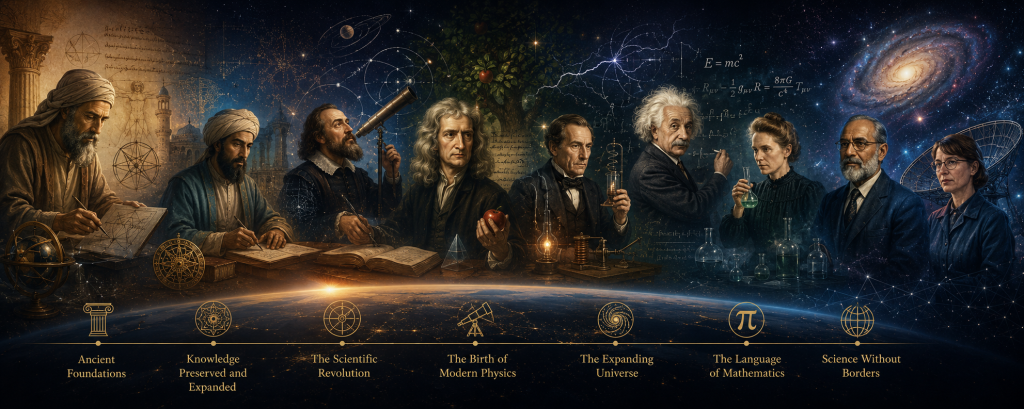
Humanity’s Search for Knowledge
Every scientific discovery begins with a curious mind.
Throughout history, remarkable men and women have dared to ask questions that others overlooked, challenge accepted ideas, and look beyond the limits of their own time. They observed the world with fresh eyes, imagined new possibilities, tested their ideas against nature, and gradually transformed our understanding of mathematics, physics, astronomy, and the Universe itself.
Some developed revolutionary theories. Others built remarkable instruments, made painstaking observations, uncovered hidden patterns, or revealed unexpected connections between seemingly unrelated phenomena. Together they remind us that science is not simply a collection of facts—it is humanity’s continuing search for knowledge and understanding.
The story of science is not the work of isolated individuals but a conversation that has continued across thousands of years. Each generation built upon the discoveries of those who came before. Euclid laid foundations that still support modern mathematics. Ibn al-Haytham transformed observation into experiment. Copernicus challenged humanity’s place in the cosmos. Galileo turned the telescope toward the heavens. Newton revealed the laws of motion and gravity. Faraday, despite having little formal education, uncovered the principles that made our electrical world possible. Maxwell united electricity, magnetism and light. Einstein changed our understanding of space and time. Every generation opened new doors for the next.
The people presented in this section come from different cultures, different centuries and different scientific disciplines, yet they share one remarkable quality: they changed the way humanity sees reality. Their discoveries continue to shape our lives, inspire new generations, and remind us that curiosity is one of the greatest forces for progress ever known.
This page is more than a collection of biographies. It is a journey through the history of human discovery—a celebration of the women and men whose questions, imagination and perseverance expanded the boundaries of knowledge and helped us better understand ourselves and the Universe we call home.
A Journey Through the History of Discovery
The story of science is a journey across continents and centuries. Every generation built upon the discoveries of those who came before, gradually expanding humanity’s understanding of the Universe and our place within it. What follows is a journey through the remarkable people whose curiosity, imagination and perseverance transformed the way we see reality.
The First Builders of Knowledge
Introduction to the ancient world.
Long before telescopes, laboratories and modern universities, there were people who looked at the world with curiosity and asked profound questions. They sought to understand the heavens, measure the Earth, explain the movements of the stars and uncover the hidden patterns of nature through observation, logic and mathematics.
Working with little more than careful thought and simple instruments, these early thinkers laid the intellectual foundations upon which all later science would be built. Their discoveries inspired generations of scholars and demonstrated that the Universe is not governed by mystery alone, but by laws that the human mind can gradually discover and understand.
The journey of scientific discovery begins here—with the first builders of knowledge.
Euclid (c. 300 BC)
Greek mathematician and the Father of Geometry.
Archimedes (c. 287–212 BC)
Greek mathematician, physicist and inventor.
Aristarchus of Samos (c. 310–230 BC)
Greek astronomer who first proposed a Sun-centred Universe.
Hipparchus (c. 190–120 BC)
Greek astronomer and founder of scientific astronomy.
Claudius Ptolemy (AD 100–170)
Greek-Egyptian astronomer, mathematician and author of the Almagest.
Knowledge Preserved and Expanded
The Golden Age of Learning
After the decline of the ancient civilizations, the pursuit of knowledge did not disappear. Across the Islamic world, scholars translated, preserved and greatly expanded the scientific works of Greece, Persia and India. From the eighth to the fourteenth century, cities such as Baghdad, Damascus, Cairo, Córdoba and Samarkand became centres of learning where mathematics, astronomy, medicine, optics and philosophy flourished.
These scholars did far more than preserve ancient knowledge. They developed new mathematical methods, refined astronomical observations, introduced experimental approaches to science and produced original discoveries that would later influence the European Renaissance and the Scientific Revolution.
Their work reminds us that the history of science belongs to no single nation or civilization. It is a shared human achievement, built through curiosity, collaboration and the willingness to learn from those who came before.
Al-Khwarizmi (c. AD 780–850)
Persian mathematician and the founder of algebra.
Ibn al-Haytham (c. AD 965–1040)
Arab physicist and pioneer of the experimental scientific method.
Al-Biruni (AD 973–1048)
Persian scholar who made remarkable contributions to astronomy, mathematics and geography.
Nasir al-Din al-Tusi (AD 1201–1274)
Persian astronomer and mathematician whose work influenced the development of modern astronomy.
The Scientific Revolution
A New View of the Universe
Between the sixteenth and seventeenth centuries, humanity’s understanding of the Universe underwent one of the greatest transformations in history. Ancient beliefs that had guided science for more than a thousand years were questioned, tested and, in many cases, replaced by new ideas supported by observation, mathematics and experiment.
This remarkable period saw the birth of the modern scientific method. Careful observation replaced unquestioned authority, experiments became essential, and mathematics emerged as the language through which nature could be understood. The Earth was no longer regarded as the centre of the Universe, and humanity’s place in the cosmos was forever changed.
The scientists of this era did not work in isolation. Each built upon the discoveries of those who came before, creating a chain of knowledge that would ultimately lead to modern physics, astronomy and space exploration.
Nicolaus Copernicus (AD 1473–1543)
Polish astronomer who placed the Sun at the centre of the Solar System.
Tycho Brahe (AD 1546–1601)
Danish astronomer whose precise observations transformed astronomy.
Galileo Galilei (AD 1564–1642)
Italian astronomer and pioneer of the scientific method.
Johannes Kepler (AD 1571–1630)
German astronomer who discovered the laws of planetary motion.
Isaac Newton (AD 1643–1727)
English physicist and mathematician who unified the heavens and the Earth through the law of universal gravitation.
The Birth of Modern Physics
Unlocking Nature´s Hidden Laws
During the nineteenth and early twentieth centuries, science entered a new era of discovery. Electricity and magnetism were united into a single theory, invisible atoms became real physical objects, and the foundations of modern physics began to emerge. Scientists discovered that nature was far richer and more complex than anyone had imagined.
The certainty of classical physics gave way to extraordinary new ideas. Space and time were no longer absolute, energy and matter were shown to be deeply connected, and the strange world of quantum mechanics revealed that reality behaves very differently on the smallest scales. These discoveries transformed not only science but also our understanding of the Universe and our place within it.
The remarkable thinkers of this period laid the foundations for much of the technology and scientific knowledge that shape our lives today.
Michael Faraday (AD 1791–1867)
English physicist and chemist who revealed the principles of electromagnetism.
James Clerk Maxwell (AD 1831–1879)
Scottish physicist who united electricity, magnetism and light into a single theory.
Max Planck (AD 1858–1947)
German physicist and founder of quantum theory.
Marie Curie (AD 1867–1934)
Polish-French physicist and chemist whose pioneering work revealed the nature of radioactivity.
Albert Einstein (AD 1879–1955)
German-born theoretical physicist whose theories transformed our understanding of space, time and gravity.
Emmy Noether (1882–1935)
The mathematician who uncovered the profound connection between symmetry and the laws of nature.
The Expanding Universe
From the Milky Way to the Cosmos
The twentieth century transformed our understanding of the Universe more profoundly than any previous era. Powerful telescopes revealed that the Milky Way is only one of billions of galaxies, while advances in physics uncovered the extraordinary lives of stars, the existence of black holes and the mysterious nature of dark matter. The Universe grew larger, stranger and more beautiful than anyone had imagined.
Astronomers and physicists worked together to answer some of humanity’s oldest questions. What are stars made of? How do galaxies evolve? Why is the Universe expanding? What happens inside a black hole? Each discovery revealed that our place in the cosmos is far smaller—and far more remarkable—than earlier generations believed.
The scientists in this chapter helped shape modern astronomy and cosmology. Their discoveries continue to influence research today and inspire new generations to explore the greatest frontier of all—the Universe itself.
Edwin Hubble (AD 1889–1953)
American astronomer who revealed that the Universe extends far beyond the Milky Way and is expanding.
Georges Lemaître (AD 1894–1966)
Belgian priest, astronomer and physicist who laid the foundations of the Big Bang theory..
Cecilia Payne (AD 1900–1979)
British-American astronomer who discovered that stars are composed primarily of hydrogen and helium.
Paul Dirac (AD 1902–1984)
A quiet genius who revealed the deep mathematical beauty of the Universe.
Subrahmanyan Chandrasekhar (AD 1910–1995)
Indian-American astrophysicist whose work transformed our understanding of stellar evolution and black holes.
Richard Feynman (AD 1918–1988)
A brilliant physicist whose curiosity and passion made the mysteries of the quantum world accessible to millions.
Abdus Salam (AD 1926–1996)
Pakistani theoretical physicist whose work on the unification of fundamental forces earned him the Nobel Prize in Physics.
Vera Rubin (AD 1928–2016)
American astronomer whose observations provided the strongest evidence for dark matter.
Stephen Hawking (AD 1942–2018)
British theoretical physicist who revolutionized our understanding of black holes and the origin of the Universe.
Jocelyn Bell Burnell (born AD 1943)
Northern Irish astrophysicist who discovered the first pulsars as a graduate student.
Carl Sagan (AD 1934–1996)
American astronomer, planetary scientist and science communicator who inspired millions to explore the Universe with curiosity and wonder.
Science Without Borders
Knowledge Belongs to Humanity
Throughout this journey we have met remarkable women and men from many civilizations, cultures and centuries. Some lived in ancient Greece, others in Baghdad, Córdoba, Florence, Cambridge, Stockholm, Lahore and countless other places. They spoke different languages, lived under different rulers and often held very different beliefs. Yet they were united by one simple idea: a desire to understand nature and share that understanding with others.
Science has never belonged to a single nation, culture or generation. Every discovery builds upon earlier discoveries, every new question leads to another, and every generation inherits knowledge that has been patiently gathered over thousands of years. The history of science reminds us that curiosity knows no borders and that the search for truth is one of humanity’s greatest shared achievements.
The Universe belongs to all of us. So does the knowledge we have gained in trying to understand it. Each generation receives this extraordinary inheritance, adds a little more to it, and passes it on to those who follow.
A Final Reflection
Every great discovery began with a question.
Every answer opened the door to new questions.
The story of science is therefore not a collection of finished answers but an endless journey of curiosity, imagination and discovery.
Somewhere today, a young student is looking at the night sky, wondering how the Universe began, what lies beyond the stars, or whether life exists elsewhere. Perhaps that curious mind will one day write the next chapter in humanity’s understanding of the cosmos.
The journey continues…
Every generation stands on the shoulders of those who came before. Our greatest responsibility is to leave stronger shoulders for those who will follow.